


Clay workshop at Brooks building
- Feb 13, 2018
- 3 min read

Room 2.43 in Brooks Building.
The past Friday we met at MMU's Brook building to brainstorm potential ideas for upcoming workshops and get to play with clay. The Brooks building has plenty of facilities which are ideal to create art.
Upon our arrival, Elle gave us relevant instructions about how to use the room we were going to work in. These instructions include the cleaning after working with clay, where each thing is located and the available tools to create art. Such instructions will be relevant when working with groups and should be shared with them.
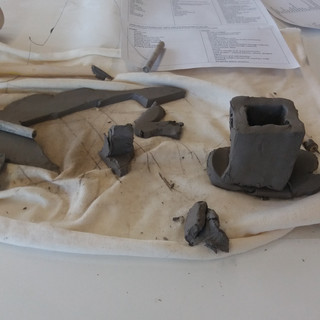
With Rebecca and Samrah, we started playing with clay and using the materials found in the room to create different shapes. Some of the materials found in the room included pieces of fabric, small shells and pine cones. While molding and creating our clay pieces, we discussed how we could get the students to interact with clay while communicating. Several ideas were suggested, among them "Pictionary" by Samrah. This idea was particularly appealing since I had something similar in mind, as mentioned in one of my first posts. However, we later came to the conclusion that, although Pictionary is an ingenious and fun activity, creating a shape with clay takes quite a while, even if it's a simple one. This was proved by the amount of time that each of us took to create and finish our own pieces.

Before working with clay, we need to unfold a piece of news paper or fabric so as not to damage the tables. I found that fabric is the best option because the paper adheres to the clay.
Another interesting idea was suggested by Rebecca, who proposed to do "a storyline". This activity would encourage the students to create a story by making structures and characters made out of clay. The storyline activity is particularly good because it would mean students have to communicate with each other in order to create a coherent narrative. Again, a disadvantage of this activity could be the time. However, teamwork would allow several people to work in their individual pieces of clay at the same time.
We also focused on a worksheet given by Elle, which contains terms, clay language, and processes associated with clay. What is interesting about this worksheet is the fact that it also contains adjectives such as "hard, wet and stiff." It was also commented that we could get the students to use language to describe the different textures and materials found in the workshop room. Rebecca suggested adapting "the pringle challenge" (also discussed in one of my previous posts). A student would be blindfolded, and then, given a material so they would have to describe its texture and guess what it is.

Cleaning after finishing it's essential as clay generates dangerous dust in the air. Tables need to be wiped using a cloth.
I suggested we could do different stations so all the ideas above could be tested during the workshop. The group would be divided into smaller groups and they would rotate through the different stations. Two of us would be in charge of each station. My main concern is that we won't get enough time to finish some of the activities since clay takes a long time to mold and adapt like we wish.
What I want to focus now is on the delivery of the workshops and how we can structure them to incorporate various activities.



Comments