


Refugee workshop (08.03.2018)
- Mar 12, 2018
- 5 min read

All pictures on this post were taken by Ambreen.
On Thursday the group headed to PLANT NOMA to deliver the first clay workshop for a refugee group. It was decided that, for this session, we would focus on the activity "make a dish out of clay" (detailed in my lesson plan post). However, we were concerned as Elle pointed out some points in the selected plans that had to be improved. For this reason, before starting the session, we had a discussion as a group to decide the structure of the workshop.
I was particularly concerned about achieving one of the workshop's aim: using abstract methods to produce language. For this reason, I printed out an adjective list that could help the participants to interact with the language while getting to touch and feel the clay. This was concieved following the idea of object-based learning, as described in the previous post. Through interrogating the clay as a material, the participants could be able not only to explore their creativity but also learn new vocabulary closely linked to their tactille discovery. Elle proposed we could divide the main activity into two, and provide a space where we could allow the participants to do this and take a look at the adjective list. Another lesson plan was made, taking ideas from Rebecca's most recent lesson plan, as well as the main points from Athinas' and Samrah's. This was posted on the wall of the clay workshop space.
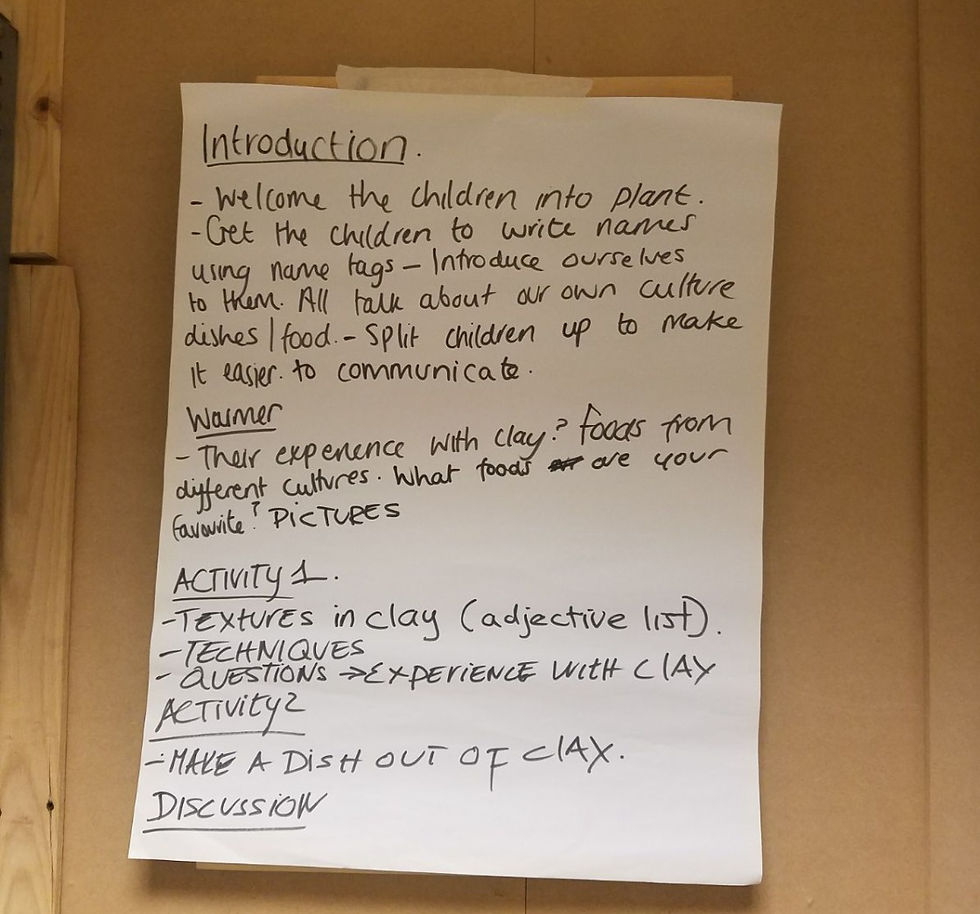
Final lesson plan. Some of the ideas were changed as we started delivering the workshop.
Before the participant's arrival, many of us expressed our worries about what could possibly go wrong. While some of my classmates were concerned about a language barrier, I was mostly worried about the participants not being able to fully engage in the activities.
When the participants finally arrived, Elle introduced the project and the Edlab team. Then, each one of us introduced to the group, which was formed by seven teenage girls from different nationalities and their two tutors. They introduced themselves and then, were asked to share which was their favourite dish. Pasta, curry, rice, and chicken were mentioned. Soon, we found out the language barrier wouldn't be a significant issue, as their command of English was good and they mostly understood what they were being asked.
As we wanted to document the sessions, the participants went on to write their favourite dish on a piece of paper on the floor, which was kind of the "warmer" stage of the session. I encouraged the girls beside me to draw their dishes and also their favourite desserts. I also asked questions, keeping in mind the aim to produce language. However, on various occasions, the answers I got were "yes" or "no." This made me question whether they were shy or my questions should had been reworded for a better understanding.
During the warmer, a conversation around food was established and several of the girls from the refugee group were eager to share their opinions. I think this made evident who were the most extroverted girls in the group. And, because of this, I thought there was some sort of imbalance in the conversation.
The next part of the session was to work with clay. In our eagerness to get things right, we forgot about the first activity written on the lesson plan, feeling the textures and choosing adjectives. Nevertheless, I asked the two girls beside me what did they think about the clay and how did it feel. They said it was cold and smooth. Everyone was encouraged to make food with the clay or anything related to it and their culture. The girls next to me weren't very interested in making food at the beginning, as they didn't know how to work with clay and were hesitant about the best way to mould it. They liked the idea of making vases, so I explained the best way to do it, showing how I did one myself. Just after that, they decided their vases were going to be plates that contained the food. They ended up making rice and chicken. Afterward, one of them made the face of a woman. I made a dish myself, traditional country and asked the girls what they thought the various elements of the dish were.

The girls working next to me focused on making small vases at first.
The other girls focused more on making elaborate dishes such as pasta, chips, an ice cream cone and more. There were conversations about the way they made it and what they did. As part of the conclusion or plenary, we expected to be able to continue and expand that discussion. A good idea was suggested by Silva, who said we could ask them to share their opinion of each other's pieces. However, this wasn't possible as half of the group had to go early and only three girls stayed until the end of the session. They were asked questions with the purpose to find out what they had learnt from the day and see if they could draw links between food, culture, and clay. Some of these questions were hard to for them to answer, which led us later to wonder if these questions had to be simplified or reworded.
Therefore, the conclusion felt lacking and it's difficult to determine the kind of learning each participant experienced.
In my opinion, I believe the workshop was a positive experience because it was able to discard some of the concerns I had, for instance, that the participants wouldn't be interested in talking about food at all or able to actually make a dish out of clay. Everyone was engaged, including me, in making food they enjoyed.
Nonetheless, despite the success of the session, there still room for improvement. The following are the key points I consider should be looked at and refine in the upcoming workshop.
* Define if we want each person to be in charge of a particular aspect or stage of the lesson. For example, in the beginning, we were hesitant about who should start and what we should say, therefore Elle took the initiative and introduced the project. However, this could be done by one of us.
* Think carefully about the questions we are going to ask. I also believe asking questions including the term "culture" were the trickiest to answer.
* Define the kind of discussion we are going to have at the end.
The next step we should take in order to improve the following workshop sessions is to focus on solving these points, rather than focusing on which main activity should we choose, as we were able to see that participants are willing to conversate and make food out of clay.


Comments